Blackjack Basic Strategy Chart
The mathematically best play for every hand you can be dealt, on the most common table in the US.
Every cell is generated by the engine that grades your hands in the trainer — not copied from a book — so the chart, the coaching, and your feedback can never disagree with each other.
6 decks · dealer hits soft 17 · double after split · double any two · late surrender · blackjack pays 3:2
Playing a different game? Single-deck, double-deck, 8-deck and S17 charts are below.
The chart: hard totals, soft totals, pairs
Hard totals
Dealer upcard| 2 | 3 | 4 | 5 | 6 | 7 | 8 | 9 | 10 | A | |
|---|---|---|---|---|---|---|---|---|---|---|
| 8 | H | H | H | H | H | H | H | H | H | H |
| 9 | H | D | D | D | D | H | H | H | H | H |
| 10 | D | D | D | D | D | D | D | D | H | H |
| 11 | D | D | D | D | D | D | D | D | D | D |
| 12 | H | H | S | S | S | H | H | H | H | H |
| 13 | S | S | S | S | S | H | H | H | H | H |
| 14 | S | S | S | S | S | H | H | H | H | H |
| 15 | S | S | S | S | S | H | H | H | R | R |
| 16 | S | S | S | S | S | H | H | R | R | R |
| 17 | S | S | S | S | S | S | S | S | S | S |
Soft totals
Dealer upcard| 2 | 3 | 4 | 5 | 6 | 7 | 8 | 9 | 10 | A | |
|---|---|---|---|---|---|---|---|---|---|---|
| A,2 | H | H | H | D | D | H | H | H | H | H |
| A,3 | H | H | H | D | D | H | H | H | H | H |
| A,4 | H | H | D | D | D | H | H | H | H | H |
| A,5 | H | H | D | D | D | H | H | H | H | H |
| A,6 | H | D | D | D | D | H | H | H | H | H |
| A,7 | D | D | D | D | D | S | S | H | H | H |
| A,8 | S | S | S | S | D | S | S | S | S | S |
| A,9 | S | S | S | S | S | S | S | S | S | S |
Pairs
Dealer upcard| 2 | 3 | 4 | 5 | 6 | 7 | 8 | 9 | 10 | A | |
|---|---|---|---|---|---|---|---|---|---|---|
| 2,2 | P | P | P | P | P | P | H | H | H | H |
| 3,3 | P | P | P | P | P | P | H | H | H | H |
| 4,4 | H | H | H | P | P | H | H | H | H | H |
| 5,5 | D | D | D | D | D | D | D | D | H | H |
| 6,6 | P | P | P | P | P | H | H | H | H | H |
| 7,7 | P | P | P | P | P | P | H | H | H | H |
| 8,8 | P | P | P | P | P | P | P | P | P | R |
| 9,9 | P | P | P | P | P | S | P | P | S | S |
| 10,10 | S | S | S | S | S | S | S | S | S | S |
| A,A | P | P | P | P | P | P | P | P | P | P |
Hard 5–7 always hit and hard 18+ always stand, so those rows are omitted. Where the chart says Double or Surrender but the table won't let you, hit instead — except soft 18 (A,7) vs 3–6 and hard 17+, where you stand.
blackjacktrainer.fyi/charts/basic-strategy — interactive chart, EV per cell, and the free trainer
Printable chart — free download
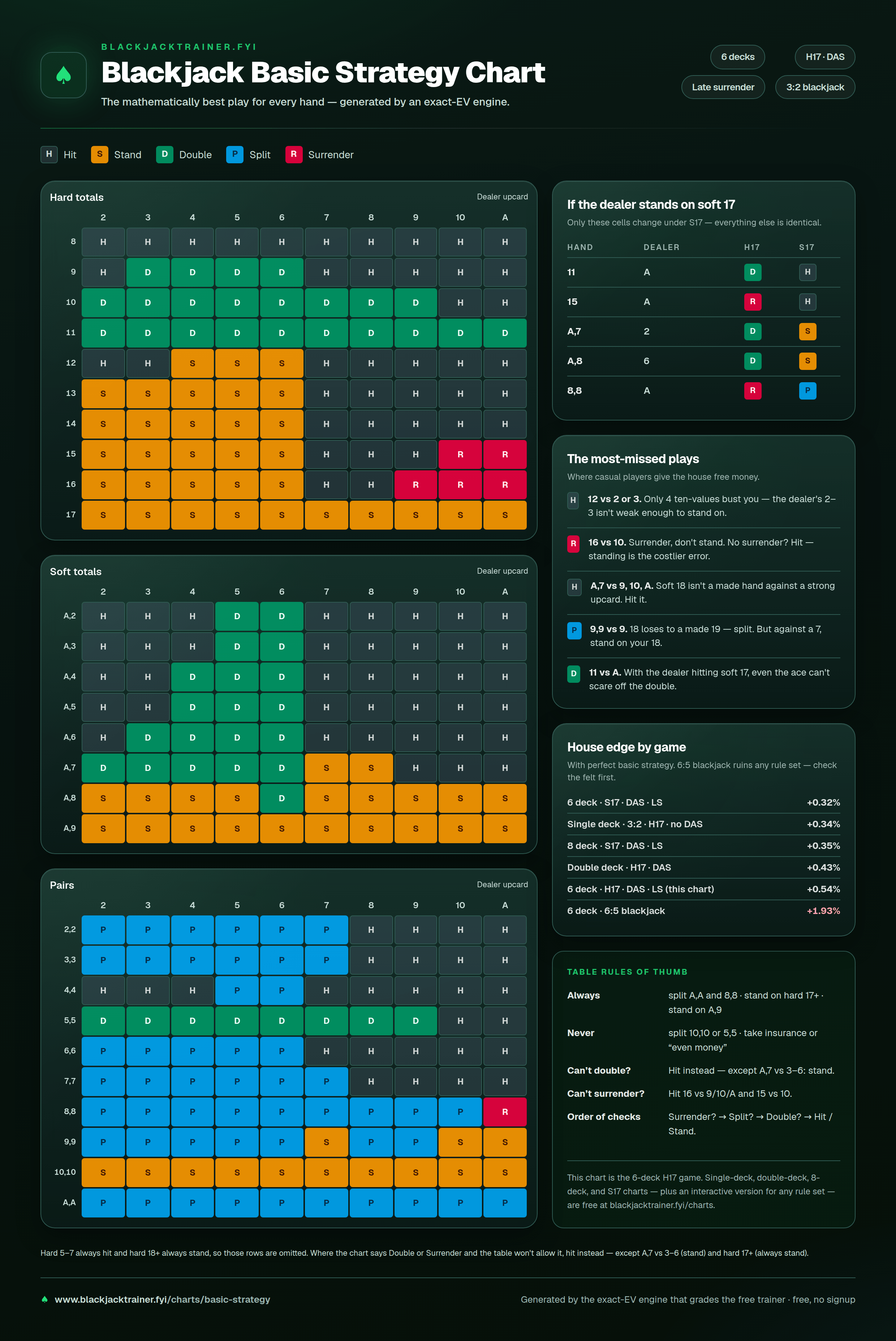
All three grids on a single sheet, exactly as the engine plays them. Print it, save it to your phone, keep it next to you while you practice.
PNG · 2480 × 3712 px · 616 KB · 6 decks, H17, DAS, late surrender
Charts for other games
Basic strategy shifts with the rules — a single-deck chart is not a shoe chart with a different label. Each page below regenerates every cell for that game and lists exactly which plays change.
Dealer stands on soft 17? (S17)
If your table's felt says the dealer stands on all 17s, 5 cells on this chart change and the house edge drops by about 0.22%. The full side-by-side — every cell that flips, and why S17 is the better game — is on the H17 vs S17 comparison.
Reading this chart
How do I use it?
Find your hand on the left, read across to the dealer's upcard, play the letter you land on. Rows are hard totals, soft totals (an ace counting as 11), and pairs — and when a hand reads two ways, pairs beat totals and soft beats hard.
How much does basic strategy actually help?
It takes the house edge to about +0.54%, down from roughly 2% for a player going on instinct. That is the largest single improvement available in blackjack, and it costs nothing. The house edge calculator prices each rule on its own.
Is one chart enough for every casino?
Almost. The core never moves, but deck count, H17/S17, DAS and surrender each shift a handful of cells — which is why this site builds the chart from the table's rules rather than printing one and hoping. Read the felt, pick the matching chart, and you're exact.
What about card counting?
Counting is built on top of this. Once the chart is automatic, Hi-Lo and the deviation chart come next — the index plays that flip specific cells when the deck runs hot or cold.
Reading it is easy. Recalling it at the table isn't.
The trainer deals real hands and grades every decision against this exact chart, so the mistakes you make here are the ones worth drilling.