Blackjack deviations, explained
Basic strategy is the best fixed way to play every hand — but it assumes a freshly shuffled shoe. Card counters know more than that: when the true count rises or falls, the correct play for a handful of hands actually changes. Those count-driven departures are called deviations, and they are where counting turns from “bet more when favorable” into playing every hand better than the chart.
- Hi-Lo system
- 6 minute read
- Free trainer included
How to read an index number
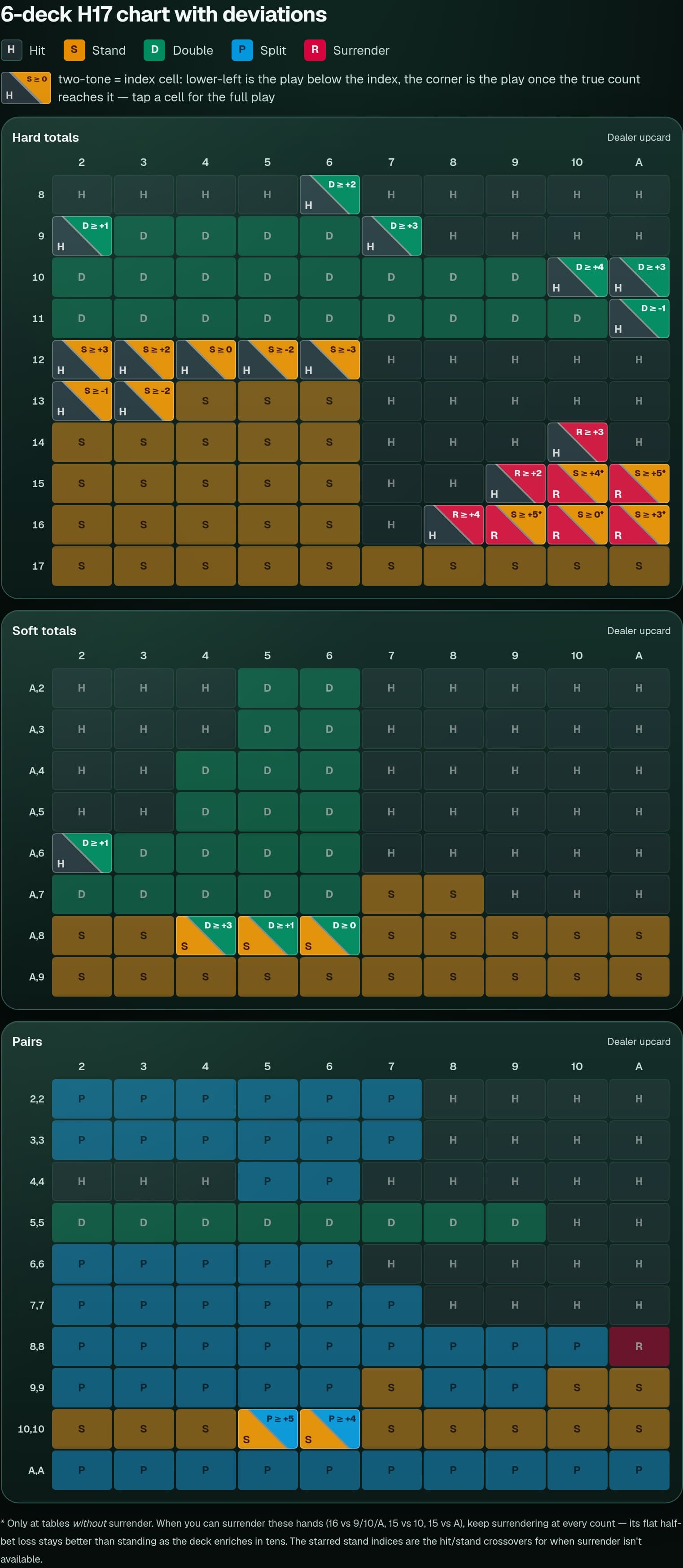
Every deviation is written as a hand, a dealer upcard, and a true-count threshold — the index. Take the most famous one: 16 vs 10, stand at true count 0 or higher. Basic strategy says hit 16 against a ten; the index says that once the remaining shoe is even slightly rich in high cards, busting becomes the bigger risk and standing wins more.
- Lower-left: below the index
- True count under 0 — play basic strategy and hit.
- Upper-right: at or above it
- True count 0 or higher — make the index play and stand.
- The number itself
- The threshold — “S ≥ 0” reads as stand at true count 0 or higher.
How many deviations are worth learning?
Far fewer than exist. Hundreds of indices have been published, but the value is extremely top-heavy: the ranked Illustrious 18 plus the Fab 4 surrenders capture most of what full deviation play is worth. Beyond those twenty-two, each additional index adds less and less — which is why nearly every counting curriculum stops there.
The rules change the numbers
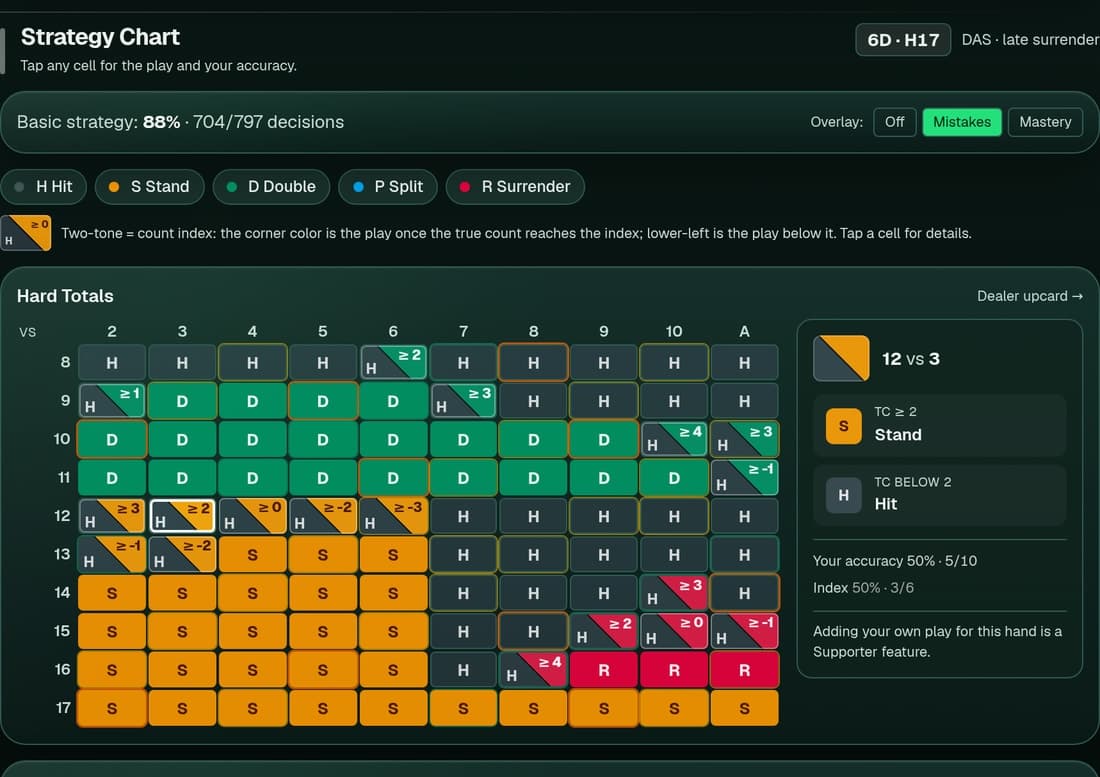
Indices are computed for a specific game. Whether the dealer hits or stands on soft 17 moves several of them, and deck count matters too — an index memorized for a 6-deck H17 shoe isn't automatically right for a double-deck S17 game. The deviation chart lists both H17 and S17 values side by side, the S17 chart renders the stand-on-soft-17 game in full, and the interactive chart regenerates every cell for the exact rules you set.
The order that actually works
Deviations are the third thing you learn, not the first. Skipping ahead is the most common way counters lose money at a table they thought they had an edge on.
Basic strategy, automatic
Every hand played correctly without thinking. An index tells you when to override the chart — useless if the chart isn't second nature yet.
A reliable count
Running count kept through a full shoe, converted to a true count on the fly. Deviations are conditioned on that number being right.
Indices, top down
Add deviations in value order — insurance first, then 16 vs 10 — so every one you learn is the most valuable one left.
Common questions
Should I learn deviations before basic strategy?
No. Deviations only make sense as departures from a strategy you already play perfectly — an index tells you when to override the chart, which is useless if the chart isn't automatic yet. Master basic strategy first, then add counting, then indices.
Do deviations work if I'm not counting?
No — every index is conditioned on the true count. Without a count you have no signal to deviate on, and basic strategy remains the best you can do.
How much are deviations worth compared to bet spreading?
Bet spreading is the bigger lever — most of a counter's edge comes from betting more in rich counts. Playing deviations adds a meaningful extra slice on top, and the EV heatmap puts dollar values on individual plays so you can see exactly what each spot is worth.
Where do these index numbers come from?
They're the standard published Hi-Lo indices — the same values taught by the major counting courses — and every page here renders them from the same engine that grades decisions in the trainer, so the reference and the practice table can never disagree.
Is this the same as the printable deviation charts counting courses hand out?
It covers the same core material: the Illustrious 18 and Fab 4 popularized by Don Schlesinger, the index set nearly every counting curriculum teaches. The difference is presentation — the deviation chart here draws every index into its basic-strategy cell with H17 and S17 values side by side, and the interactive chart regenerates the indices for your exact deck count and rules instead of one fixed ruleset.
Indices for your own table
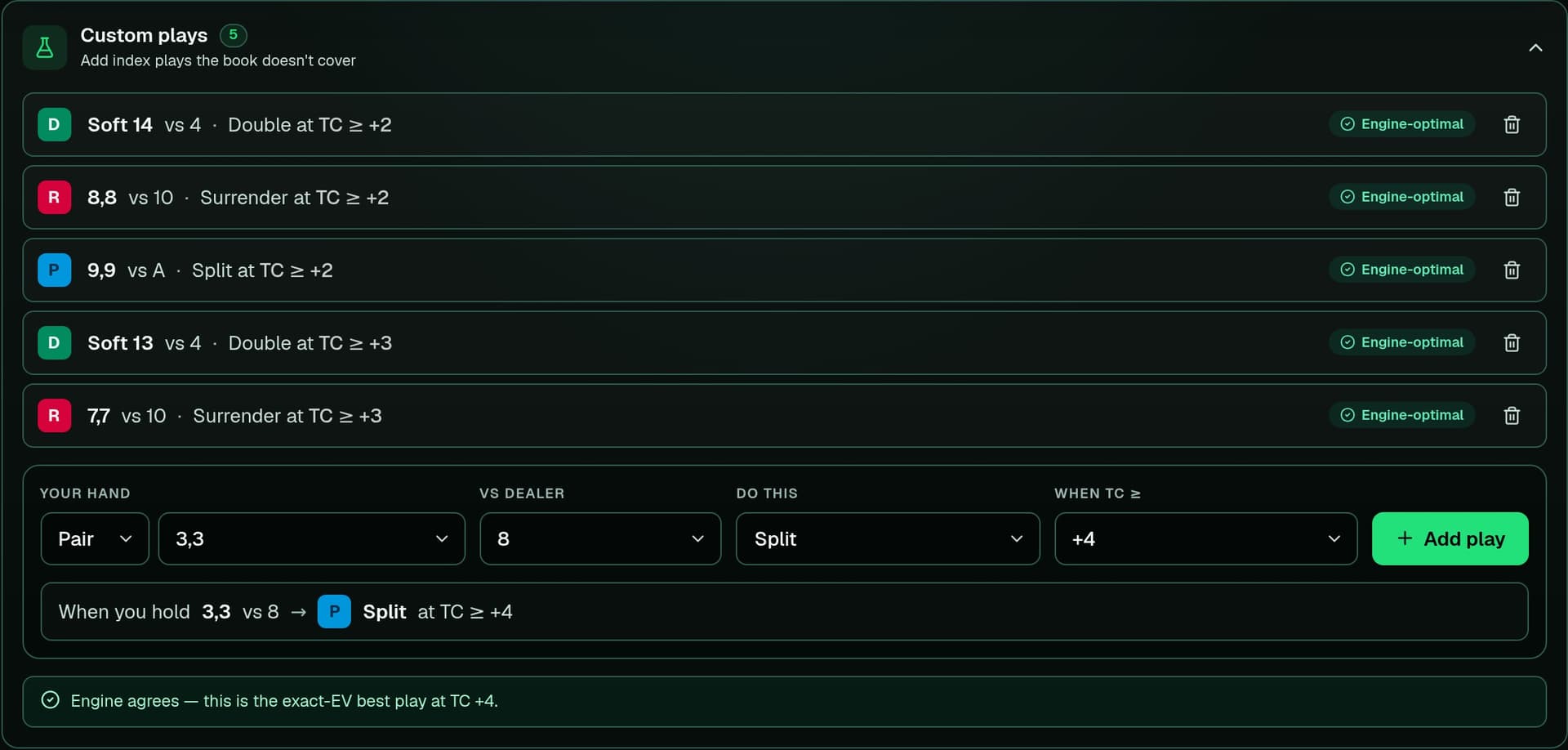
Playing a game the published numbers weren't derived for — a pitch game, or no surrender? Indices move when the rules do, which is also why two published charts can disagree by a point. How a blackjack index generator works shows the EV crossover being computed.
Drill them until they're automatic
The free blackjack trainer keeps a live Hi-Lo count while you play and grades every decision — including deviations — against the exact indices for your table rules, with a practice mode that deals you straight into index spots at the counts where they matter.
Open the free trainer