Blackjack Deviation Chart: Illustrious 18 & Fab 4
Every standard Hi-Lo index play — the ranked Illustrious 18 and the Fab 4 — on one color-coded chart for the common 6-deck game (H17, DAS, late surrender), generated by the same engine that grades every decision in the free blackjack trainer.
6-deck H17 chart with deviations
Hard totals
Dealer upcard| 2 | 3 | 4 | 5 | 6 | 7 | 8 | 9 | 10 | A | |
|---|---|---|---|---|---|---|---|---|---|---|
| 8 | H | H | H | H | HD ≥ +2 8 vs 6 Hi-Lo index play DTC ≥ +2Double HTC below +2Hit | H | H | H | H | H |
| 9 | HD ≥ +1 9 vs 2 Hi-Lo index play DTC ≥ +1Double HTC below +1Hit | D | D | D | D | HD ≥ +3 9 vs 7 Hi-Lo index play DTC ≥ +3Double HTC below +3Hit | H | H | H | H |
| 10 | D | D | D | D | D | D | D | D | HD ≥ +4 10 vs 10 Hi-Lo index play DTC ≥ +4Double HTC below +4Hit | HD ≥ +3 10 vs A Hi-Lo index play DTC ≥ +3Double HTC below +3Hit |
| 11 | D | D | D | D | D | D | D | D | D | HD ≥ -1 11 vs A Hi-Lo index play DTC ≥ -1Double HTC below -1Hit |
| 12 | HS ≥ +3 12 vs 2 Hi-Lo index play STC ≥ +3Stand HTC below +3Hit | HS ≥ +2 12 vs 3 Hi-Lo index play STC ≥ +2Stand HTC below +2Hit | HS ≥ 0 12 vs 4 Hi-Lo index play STC ≥ 0Stand HTC below 0Hit | HS ≥ -2 12 vs 5 Hi-Lo index play STC ≥ -2Stand HTC below -2Hit | HS ≥ -3 12 vs 6 Hi-Lo index play STC ≥ -3Stand HTC below -3Hit | H | H | H | H | H |
| 13 | HS ≥ -1 13 vs 2 Hi-Lo index play STC ≥ -1Stand HTC below -1Hit | HS ≥ -2 13 vs 3 Hi-Lo index play STC ≥ -2Stand HTC below -2Hit | S | S | S | H | H | H | H | H |
| 14 | S | S | S | S | S | H | H | H | HR ≥ +3 14 vs 10 Hi-Lo index play RTC ≥ +3Surrender HTC below +3Hit | H |
| 15 | S | S | S | S | S | H | H | HR ≥ +2 15 vs 9 Hi-Lo index play RTC ≥ +2Surrender HTC below +2Hit | HR ≥ 0 15 vs 10 Hi-Lo index play RSurrender offered, TC ≥ 0Surrender SNo surrender, TC ≥ +4Stand HTC below 0Hit | HR ≥ -1 15 vs A Hi-Lo index play RSurrender offered, TC ≥ -1Surrender SNo surrender, TC ≥ +5Stand HTC below -1Hit |
| 16 | S | S | S | S | S | H | HR ≥ +4 16 vs 8 Hi-Lo index play RTC ≥ +4Surrender HTC below +4Hit | RS ≥ +5 16 vs 9 Hi-Lo index play RWith surrender offeredSurrender at every count SNo surrender, TC ≥ +5Stand HNo surrender, TC below +5Hit | RS ≥ 0 16 vs 10 Hi-Lo index play RWith surrender offeredSurrender at every count SNo surrender, TC ≥ 0Stand HNo surrender, TC below 0Hit | RS ≥ +3 16 vs A Hi-Lo index play RWith surrender offeredSurrender at every count SNo surrender, TC ≥ +3Stand HNo surrender, TC below +3Hit |
| 17 | S | S | S | S | S | S | S | S | S | S |
Soft totals
Dealer upcard| 2 | 3 | 4 | 5 | 6 | 7 | 8 | 9 | 10 | A | |
|---|---|---|---|---|---|---|---|---|---|---|
| A,2 | H | H | H | D | D | H | H | H | H | H |
| A,3 | H | H | H | D | D | H | H | H | H | H |
| A,4 | H | H | D | D | D | H | H | H | H | H |
| A,5 | H | H | D | D | D | H | H | H | H | H |
| A,6 | HD ≥ +1 A,6 vs 2 Hi-Lo index play DTC ≥ +1Double HTC below +1Hit | D | D | D | D | H | H | H | H | H |
| A,7 | D | D | D | D | D | S | S | H | H | H |
| A,8 | S | S | SD ≥ +3 A,8 vs 4 Hi-Lo index play DTC ≥ +3Double STC below +3Stand | SD ≥ +1 A,8 vs 5 Hi-Lo index play DTC ≥ +1Double STC below +1Stand | SD ≥ 0 A,8 vs 6 Hi-Lo index play DTC ≥ 0Double STC below 0Stand | S | S | S | S | S |
| A,9 | S | S | S | SD ≥ +5 A,9 vs 5 Hi-Lo index play DTC ≥ +5Double STC below +5Stand | SD ≥ +4 A,9 vs 6 Hi-Lo index play DTC ≥ +4Double STC below +4Stand | S | S | S | S | S |
Pairs
Dealer upcard| 2 | 3 | 4 | 5 | 6 | 7 | 8 | 9 | 10 | A | |
|---|---|---|---|---|---|---|---|---|---|---|
| 2,2 | P | P | P | P | P | P | H | H | H | H |
| 3,3 | P | P | P | P | P | P | H | H | H | H |
| 4,4 | H | H | H | P | P | H | H | H | H | H |
| 5,5 | D | D | D | D | D | D | D | D | H | H |
| 6,6 | P | P | P | P | P | H | H | H | H | H |
| 7,7 | P | P | P | P | P | P | H | H | H | H |
| 8,8 | P | P | P | P | P | P | P | P | P | R |
| 9,9 | P | P | P | P | P | SP ≥ +3 9,9 vs 7 Hi-Lo index play PTC ≥ +3Split STC below +3Stand | P | P | S | S |
| 10,10 | S | S | S | SP ≥ +5 10,10 vs 5 Hi-Lo index play PTC ≥ +5Split STC below +5Stand | SP ≥ +4 10,10 vs 6 Hi-Lo index play PTC ≥ +4Split STC below +4Stand | S | S | S | S | S |
| A,A | P | P | P | P | P | P | P | P | P | P |
* Only at tables without surrender — the starred stand indices are the hit/stand crossovers for when you can't give the hand up. Where surrender is offered: 16 vs 9/10/A keep surrendering at every count, while 15 vs 10 and 15 vs A follow the Fab 4 index in the cell — surrender at the index and above, hit below it (the deck is small-card rich, so playing the hand out beats the flat half-bet loss).
blackjacktrainer.fyi/charts/deviations — interactive chart, EV per index, and the free trainer
Printable chart — free download
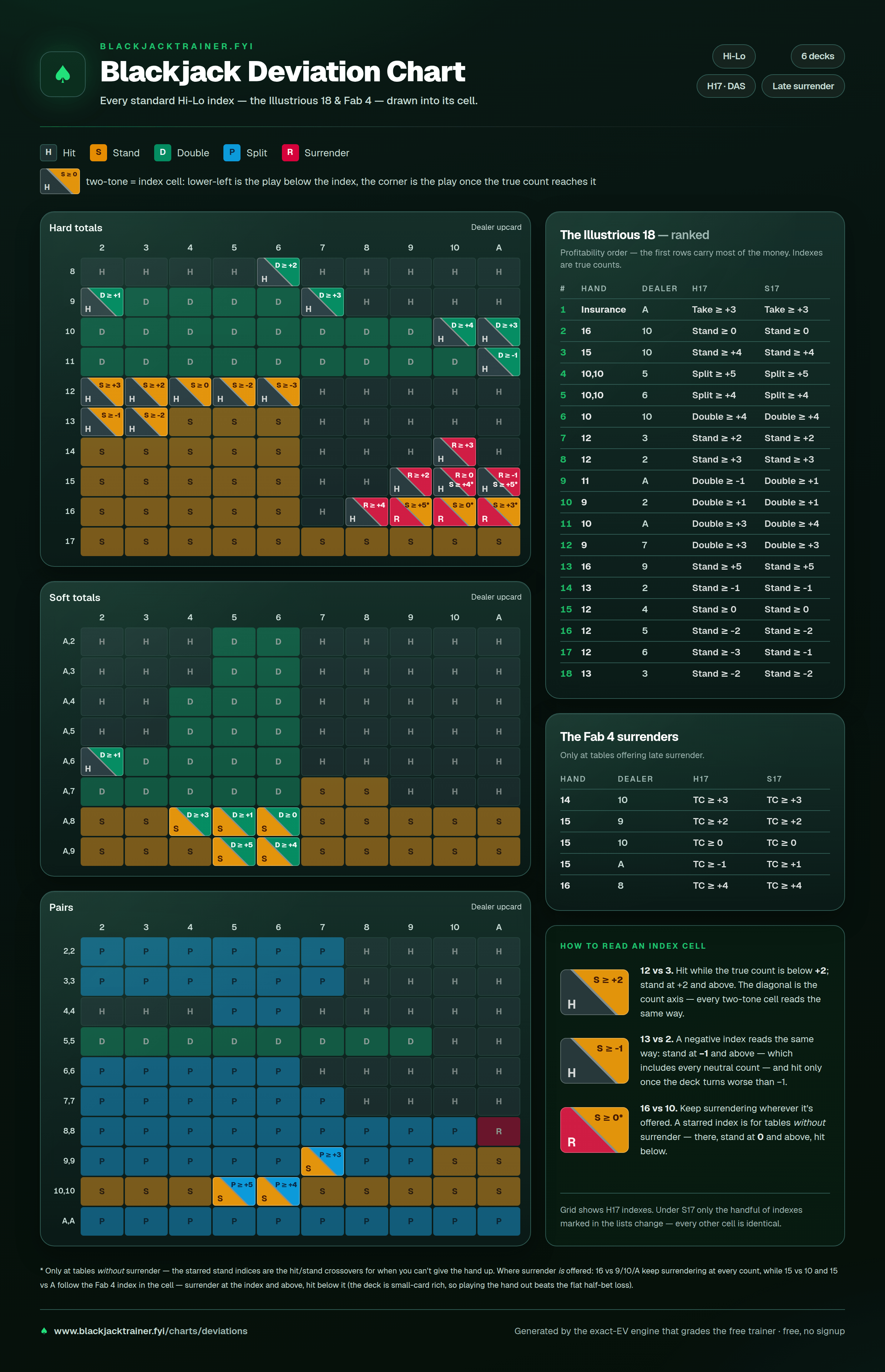
The whole reference in a single image — all three grids, the ranked Illustrious 18, and the Fab 4, exactly as the engine plays them. Print it, save it to your phone, study it away from the table.
PNG · 2480 × 3844 px · 618 KB · 6 decks, H17, DAS, late surrender
The Illustrious 18 list, ranked by value
Don Schlesinger's list in profitability order — the first few rows carry most of the money, so if you only learn part of it, learn from the top down. Insurance at true count +3 is #1; the famous 16 vs 10 stand is #2.
| # | Your hand | Dealer shows | H17 index play | S17 index play |
|---|---|---|---|---|
| 1 | Insurance | A | Take at TC ≥ +3 | Take at TC ≥ +3 |
| 2 | 16 | 10 | Stand at TC ≥ 0 | Stand at TC ≥ 0 |
| 3 | 15 | 10 | Stand at TC ≥ +4 | Stand at TC ≥ +4 |
| 4 | 10,10 | 5 | Split at TC ≥ +5 | Split at TC ≥ +5 |
| 5 | 10,10 | 6 | Split at TC ≥ +4 | Split at TC ≥ +4 |
| 6 | 10 | 10 | Double at TC ≥ +4 | Double at TC ≥ +4 |
| 7 | 12 | 3 | Stand at TC ≥ +2 | Stand at TC ≥ +2 |
| 8 | 12 | 2 | Stand at TC ≥ +3 | Stand at TC ≥ +3 |
| 9 | 11 | A | Double at TC ≥ -1 | Double at TC ≥ +1 |
| 10 | 9 | 2 | Double at TC ≥ +1 | Double at TC ≥ +1 |
| 11 | 10 | A | Double at TC ≥ +3 | Double at TC ≥ +4 |
| 12 | 9 | 7 | Double at TC ≥ +3 | Double at TC ≥ +3 |
| 13 | 16 | 9 | Stand at TC ≥ +5 | Stand at TC ≥ +5 |
| 14 | 13 | 2 | Stand at TC ≥ -1 | Stand at TC ≥ -1 |
| 15 | 12 | 4 | Stand at TC ≥ 0 | Stand at TC ≥ 0 |
| 16 | 12 | 5 | Stand at TC ≥ -2 | Stand at TC ≥ -2 |
| 17 | 12 | 6 | Stand at TC ≥ -3 | Stand at TC ≥ -1 |
| 18 | 13 | 3 | Stand at TC ≥ -2 | Stand at TC ≥ -2 |
The Fab 4 surrenders
The highest-value surrender indices (with the companion 16 vs 8 index). They only apply at tables offering late surrender.
| Your hand | Dealer shows | H17 index play | S17 index play |
|---|---|---|---|
| 14 | 10 | Surrender at TC ≥ +3 | Surrender at TC ≥ +3 |
| 15 | 9 | Surrender at TC ≥ +2 | Surrender at TC ≥ +2 |
| 15 | 10 | Surrender at TC ≥ 0 | Surrender at TC ≥ 0 |
| 15 | A | Surrender at TC ≥ -1 | Surrender at TC ≥ +1 |
| 16 | 8 | Surrender at TC ≥ +4 | Surrender at TC ≥ +4 |
What changes under S17
When the dealer stands on soft 17, only these indices move — every other cell in the chart is identical. A dash means no standard index exists under that rule. Playing an S17 table? The S17 deviation chart renders the full grid for that game.
| Your hand | Dealer shows | H17 index play | S17 index play |
|---|---|---|---|
| 11 | A | Double at TC ≥ -1 | Double at TC ≥ +1 |
| 10 | A | Double at TC ≥ +3 | Double at TC ≥ +4 |
| 12 | 6 | Stand at TC ≥ -3 | Stand at TC ≥ -1 |
| 16 | A | Stand at TC ≥ +3 | Stand at TC ≥ +5 |
| 15 | A | Stand at TC ≥ +5 | — |
| A,8 (soft 19) | 6 | Double at TC ≥ 0 | Double at TC ≥ +1 |
| A,9 (soft 20) | 6 | Double at TC ≥ +4 | Double at TC ≥ +5 |
| 15 | A | Surrender at TC ≥ -1 | Surrender at TC ≥ +1 |
Reading this chart
What does a two-tone cell mean?
Both sides of one index. The lower-left color is the basic-strategy play while the true count is below the index; the corner color is the play once the count reaches it. The number in the cell is the index itself.
What game is this chart for?
The common 6-deck game: dealer hits soft 17, double after split allowed, late surrender offered — with the S17 column showing where standing on soft 17 moves an index. For any other rule set, the interactive chart regenerates every cell for the exact table you play.
Why might another site's chart show slightly different numbers?
Indices depend on the rules and the rounding conventions used when they were computed, so published tables differ by a point here and there. These are the standard Hi-Lo values, and they're rendered from the same engine that grades your play in the trainer — the chart and your practice feedback always agree.
How to actually learn these
Recalling the right index mid-shoe is the hard part, not reading the chart. The trainer keeps a live Hi-Lo count and grades every decision against this chart as you play, and the interactive chart can preview any true count to show exactly which cells flip. To see how much each spot is actually worth in dollars, see the EV heatmap.