Blackjack index generator: where the numbers come from
Every published index — stand 16 vs 10 at true count 0, insure at +3 — is the output of a calculation somebody ran once and printed. A generator runs it for your table instead. Here is the calculation, drawn.
What a true-count index is
Basic strategy answers one question — what is the best play against a freshly shuffled shoe? — and its answer is fixed. But the correct play isn't a property of the hand; it's a property of the cards still in the shoe. An index is the true count at which the answer flips.
16 vs 10, as the chart draws it
Below TC 0 — hit. Basic strategy, the play you make in a cold or neutral shoe.
At TC 0 and above — stand. The index play. The corner label is the threshold.
The crossover, drawn
An index isn't a rule of thumb — it's the point where two curves swap places. Here are both of them for the most-played index in the game, priced by the same engine that grades your hands in the trainer.
Neither line is above zero.
16 against a ten is a losing hand at every count. The index doesn't pick a winner — it picks which way you lose less.
The gap is thin where it matters.
The two lines run within a cent of each other for several counts around the crossover, which is exactly why reputable charts print different numbers for this cell.
How a generator finds it: four steps
- 1
Turn the count into a deck
A true count is a claim about what's left. Hi-Lo tags sum to zero over a full shoe, so a shoe at true count t with d decks left has a tag sum of −t × d. The model moves t × d ÷ 2 cards out of the 2–6 ranks into the tens and aces. Card count unchanged; only the mix moves.
- 2
Price every legal action
Against that composition, compute the exact EV of standing, hitting, doubling, splitting and surrendering — full dealer recursion, no simulation, no lookup. The best play is the highest-EV one.
- 3
Sweep the count
Repeat at every integer true count from -6 to +8 and watch which action wins. The first count where the winner changes is the crossover — and the crossover is the index.
- 4
Throw away the noise
A crossover worth a hundredth of a cent per dollar at its threshold is a rounding artifact, not an index. What survives is a play that pays for the memorization.
Four cells, worked
6-deck H17, no surrender — the reference table the Illustrious 18 is quoted for. Basic-strategy and index columns are read from the same data the trainer grades against.
| Cell | Basic strategy | H17 index | S17 index |
|---|---|---|---|
| 16 vs 10The most-played index in the game. A 16 busts so often that a slightly ten-rich shoe makes standing the better of two bad options. | Hit | Stand≥ 0 | Stand≥ 0 |
| 12 vs 3Close to a coin flip. Extra tens raise your bust risk and the dealer's at once, and standing takes the lead first. | Hit | Stand≥ +2 | Stand≥ +2 |
| 10 vs 10A doubling index, not a standing one — the ten-rich deck that helps the dealer's ten helps your one-card draw more. | Hit | Double≥ +4 | Double≥ +4 |
| A,8 vs 6The low-side case. H17 basic already doubles here, so the index marks where you stop — below it, take the 19. | DoubleS17: Stand | Double≥ 0 | Double≥ +1 |
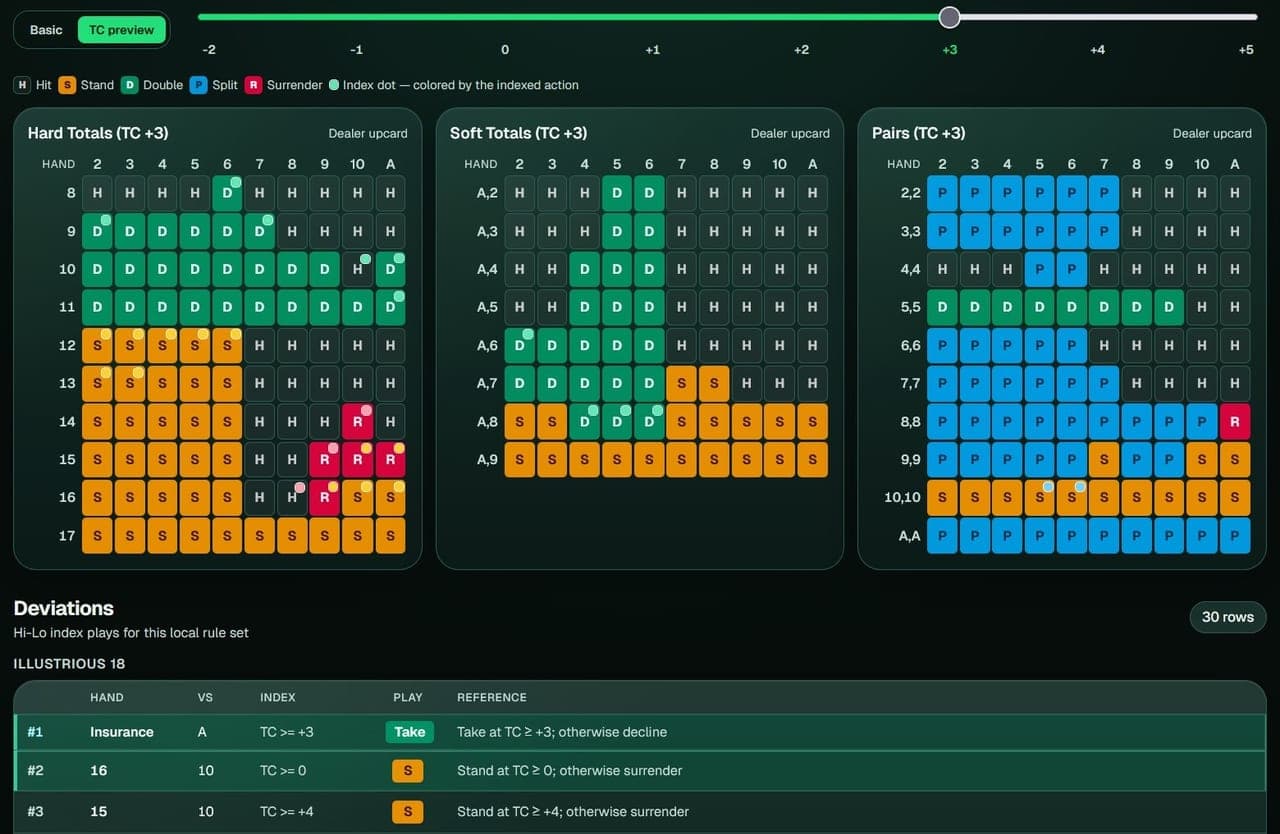
The first three read the obvious way: basic strategy below the number, index play at or above it. A,8 vs 6 is the one that trips people. Under H17 the book already doubles soft 19 there, so its index marks where you stop — yet tables still print it as "double at TC ≥ …", which is why a chart can look like it's telling you to make a play you were already making. Every index drawn into its own cell on the full blackjack deviation chart.
Why an index moves when the rules move
An index is a crossover between two EVs, so anything that shifts either EV shifts the crossover. That is the whole argument for generating instead of copying.
11 vs A
- H17
- Double≥ -1
- S17
- Double≥ +1
12 vs 6
- H17
- Stand≥ -3
- S17
- Stand≥ -1
Soft 17
A dealer who hits soft 17 busts more but also makes more 18s–21s, shifting the value of standing on a stiff. Some indices don't notice; others move two points.
Deck count
Pitch games run on their own basic strategy, so the play the index departs from is different before the count is involved. A "6-deck H17" chart is the wrong tool at a double-deck table.
Surrender & doubling
Late surrender caps the downside on the exact stiffs that carry the best standing indices, so several move or vanish. Restricting doubles to 9–11 can delete a doubling index outright.
The interactive blackjack strategy chart regenerates every cell for the exact combination you set, so you can watch this happen instead of taking it on faith.
Why published charts disagree by a point
Compare two respected lists and you'll find cells a point apart. They answered slightly different questions.
Rounding
A real crossover lands somewhere like +1.6. Charts round to an integer you can act on, and authors round in different directions.
Assumed rules
Surrender, DAS and resplit rules all move stiff-hand indices, and lists rarely restate their assumptions beside every number.
True-count convention
Counters who floor the true count are playing a different threshold than counters who round to nearest. Some lists are published pre-adjusted for one.
The composition model
A balanced count-to-composition model and a full combinatorial analyzer agree to well within a point — but not always on the same side of an integer.
The practical upshot: a one-point disagreement is noise, and playing the "wrong" side of it for one hand costs a fraction of a cent per dollar. This app grades against the published numbers because they are what the community studies from — and its generator agrees with every one of them to within a point, which is the bar its test suite enforces.
Run it on your own table
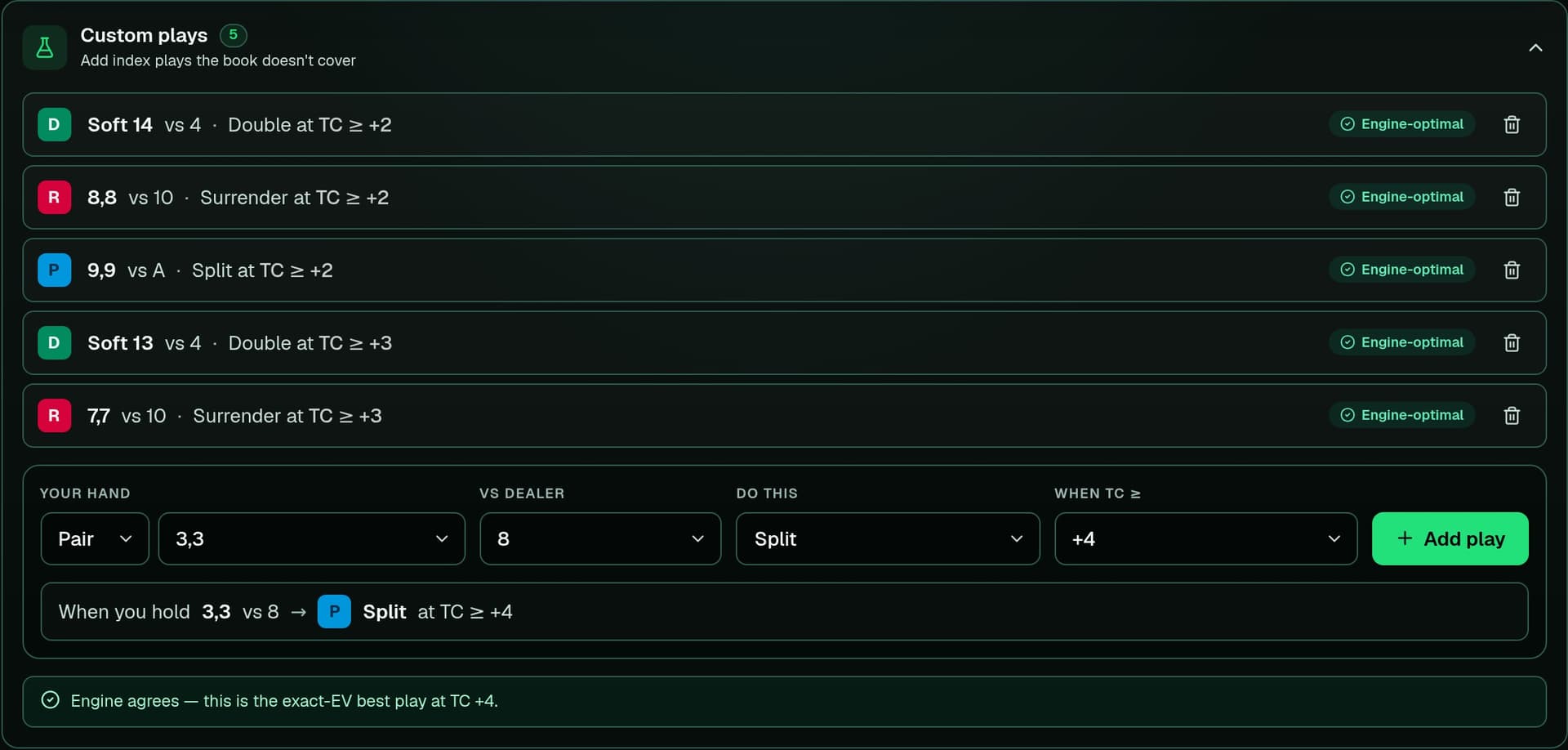
Set your decks, soft-17 rule, DAS, surrender and doubling limits in the deviations section of the Learn page, then write an index play — hand, upcard, action, true count. The engine prices it against its own best line at that count before you save, naming the action it would play and what your rule gives up in cents per dollar. You can override any published index with your own number too. Free; index editing needs an account.
Whatever you settle on is only worth what you can recall mid-shoe. The free blackjack trainer keeps a live Hi-Lo count and grades every decision against your index set — published, overridden or your own — while showing the exact EV of each action as you play.
Index generator questions
Should I play generated indices instead of published ones?
For a standard 6-deck game, no. The published Illustrious 18 already sits within a point of what any correct generator produces, and you can check yourself against a book. Generating earns its keep when your table is unusual — a pitch game, restricted doubling, no surrender where the chart assumed it.
Does an index generator work for counting systems other than Hi-Lo?
The method does; the numbers don't transfer. Step one converts a count into a deck composition, and that conversion is specific to the system's tags. Never mix index lists across systems. Everything on this site is Hi-Lo.
Why do some indices come out negative?
Because the crossover can sit below zero. 13 vs 2 and 12 vs 4 are cells where basic strategy stands and the count has to go negative before hitting takes the lead. Real deviations — they just fire in cold shoes.
How is this different from a strategy chart generator?
A chart generator answers "what is the best play at a neutral deck" — one answer per cell. An index generator answers "at what count does this cell's answer change" — a threshold that only exists for cells close enough to tip. Most of the grid has no index at all.
How many generated indices are worth learning?
Far fewer than a generator hands you. A full shoe scan turns up dozens of genuine crossovers, but their value falls off a cliff after the first twenty — which is why the Illustrious 18 is ranked. Use a generator to check the top of that list against your table, not to expand it.
New to index plays? Blackjack deviations explained covers what they are and when they fire.