The Illustrious 18: blackjack's most
valuable deviations
Don Schlesinger's ranked list of the eighteen Hi-Lo index plays that capture most of the value of card counting — published in Blackjack Attack and still the standard set taught by every serious counting course. Learn these eighteen and you bank the large majority of what full deviation play is worth, without memorizing a hundred fringe indices.
- Hi-Lo system
- Ranked by value
- H17 and S17 indices
Learn these two first
Value falls off quickly down the list, and the first two rows are in a class of their own. If you never learn another index, learn these.
The most common stiff hand in the game. The index flips it from hit to stand the moment the count is even slightly positive.
A losing side bet by default that turns profitable at true count +3. It applies to every hand you hold when the dealer shows an ace.
The full Illustrious 18, in order of value
Ranked by how much each play is worth — the first rows carry most of the money, so learn from the top down. Where the H17 and S17 indices differ, both are shown; the index play is what you do once the true count reaches the number, and basic strategy applies below it.
- 1InsuranceTake at TC ≥ +3
- 216 vs 10Stand at TC ≥ 0
- 315 vs 10Stand at TC ≥ +4
- 410,10 vs 5Split at TC ≥ +5
- 510,10 vs 6Split at TC ≥ +4
- 610 vs 10Double at TC ≥ +4
- 712 vs 3Stand at TC ≥ +2
- 812 vs 2Stand at TC ≥ +3
- 911 vs ADouble at TC ≥ -1S17 · Double at TC ≥ +1
- 109 vs 2Double at TC ≥ +1
- 1110 vs ADouble at TC ≥ +3S17 · Double at TC ≥ +4
- 129 vs 7Double at TC ≥ +3
- 1316 vs 9Stand at TC ≥ +5
- 1413 vs 2Stand at TC ≥ -1
- 1512 vs 4Stand at TC ≥ 0
- 1612 vs 5Stand at TC ≥ -2
- 1712 vs 6Stand at TC ≥ -3S17 · Stand at TC ≥ -1
- 1813 vs 3Stand at TC ≥ -2
Tinted rows are the top 5 by value — the ones worth learning first.
The Fab 4 surrenders
Schlesinger's companion list: the late-surrender indices worth learning alongside the Illustrious 18. They only apply at tables that offer late surrender — and 15 vs A is the one the soft-17 rule moves most.
- 14 vs 10Surrender at TC ≥ +3
- 15 vs 9Surrender at TC ≥ +2
- 15 vs 10Surrender at TC ≥ 0
- 15 vs ASurrender at TC ≥ -1S17 · Surrender at TC ≥ +1
- 16 vs 8Surrender at TC ≥ +4
The same list, drawn into the chart
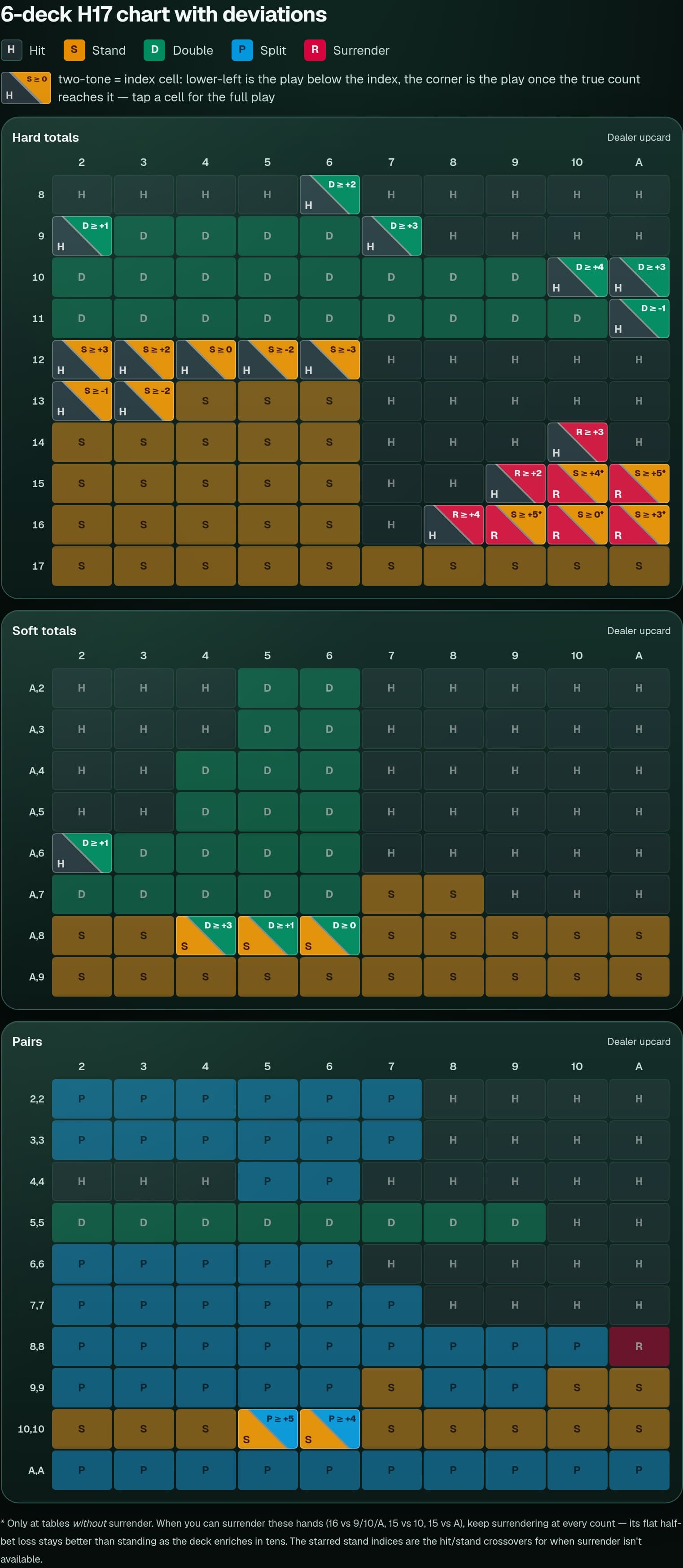
A ranked list is how you memorize them; a grid is how you check yourself. Every index above also lives in its own hand-vs-dealer cell on the chart, two-tone: the play below the index in the lower-left corner, the index play above it.
Illustrious 18 questions, answered
Do I need to learn all eighteen?
No — the list is ranked so you don't have to. The first several plays carry most of the value; many successful counters play with the top ten or twelve and add the rest later. Learning them in rank order means every deviation you add is the most valuable one remaining.
Do the indices change with the rules?
A few do. Whether the dealer hits or stands on soft 17 moves a handful of indices — both variants are shown in the list above, the deviation chart has a section for exactly which cells differ, and the S17 chart renders that game in full.
Which counting system are these indices for?
Hi-Lo, using the true count (running count divided by decks remaining). Other counting systems publish their own index numbers — these values are not interchangeable across systems.
Reading the list is the easy part
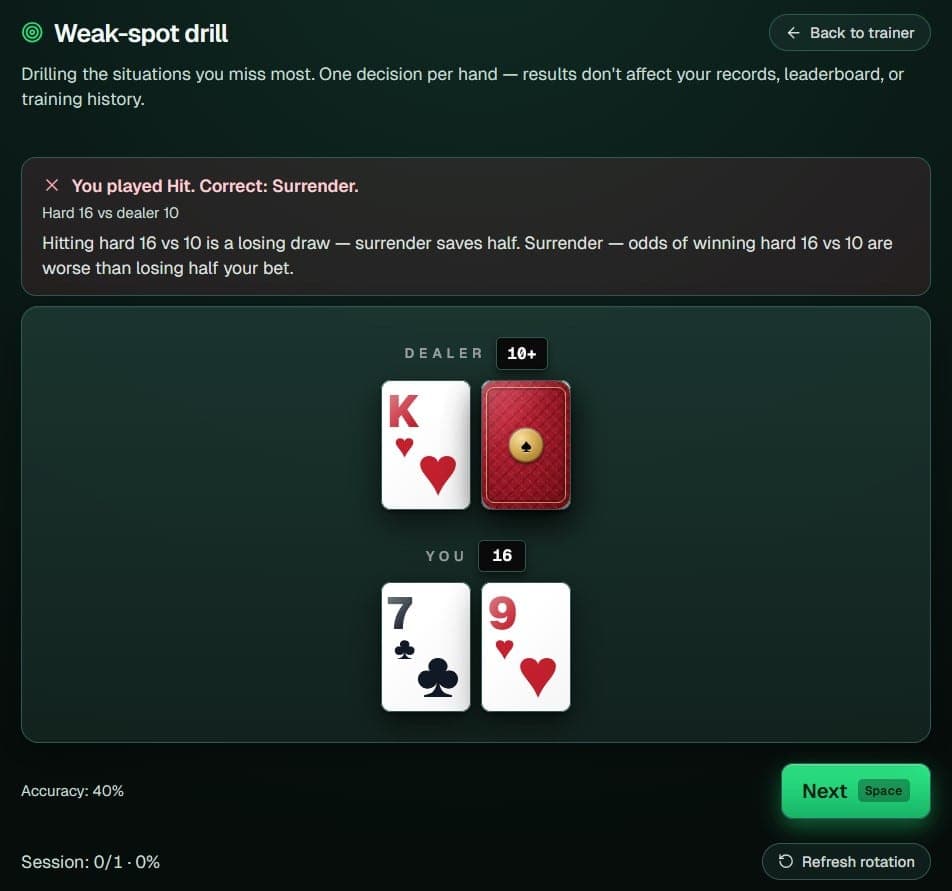
Recalling the right index mid-shoe, with a live count running and a dealer waiting, is what needs reps. Deviation practice deals you straight into Illustrious 18 spots at the counts where they matter, and weak-spot drills rebuild the ones you keep missing.
Practice them at a live table
The free blackjack trainer keeps a live Hi-Lo count and grades every decision against these exact indices as you play — with a practice mode that deals you straight into Illustrious 18 spots.
Open the free trainer